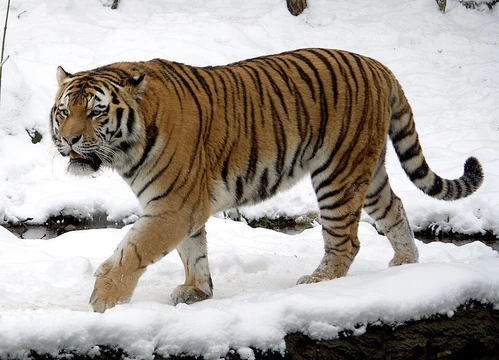
Siberian tiger
A northern tiger population surviving in the Russian Far East.

Dave Pape · Public domain
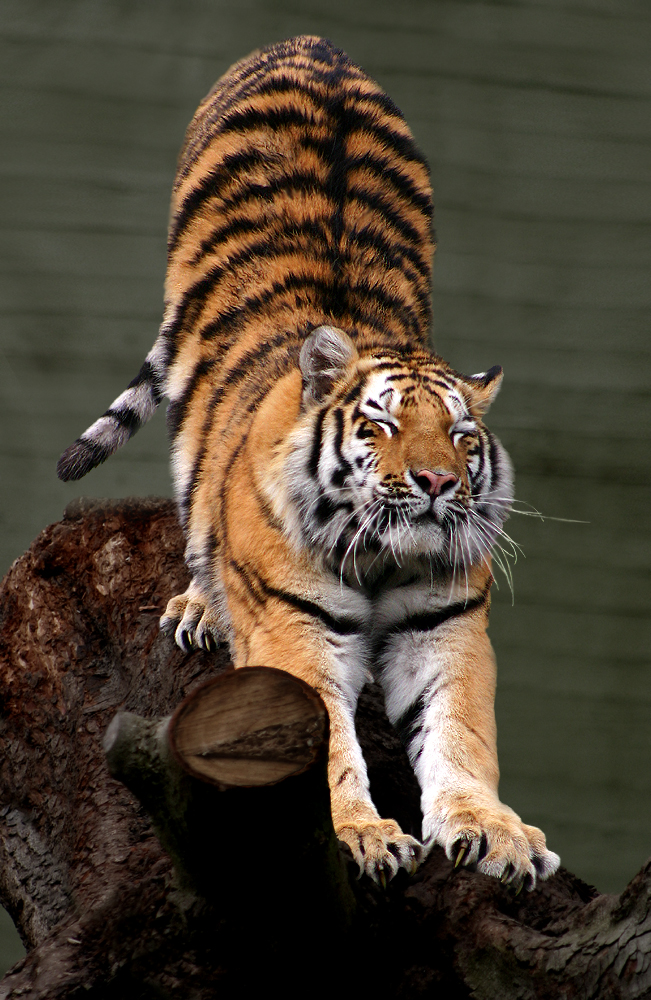
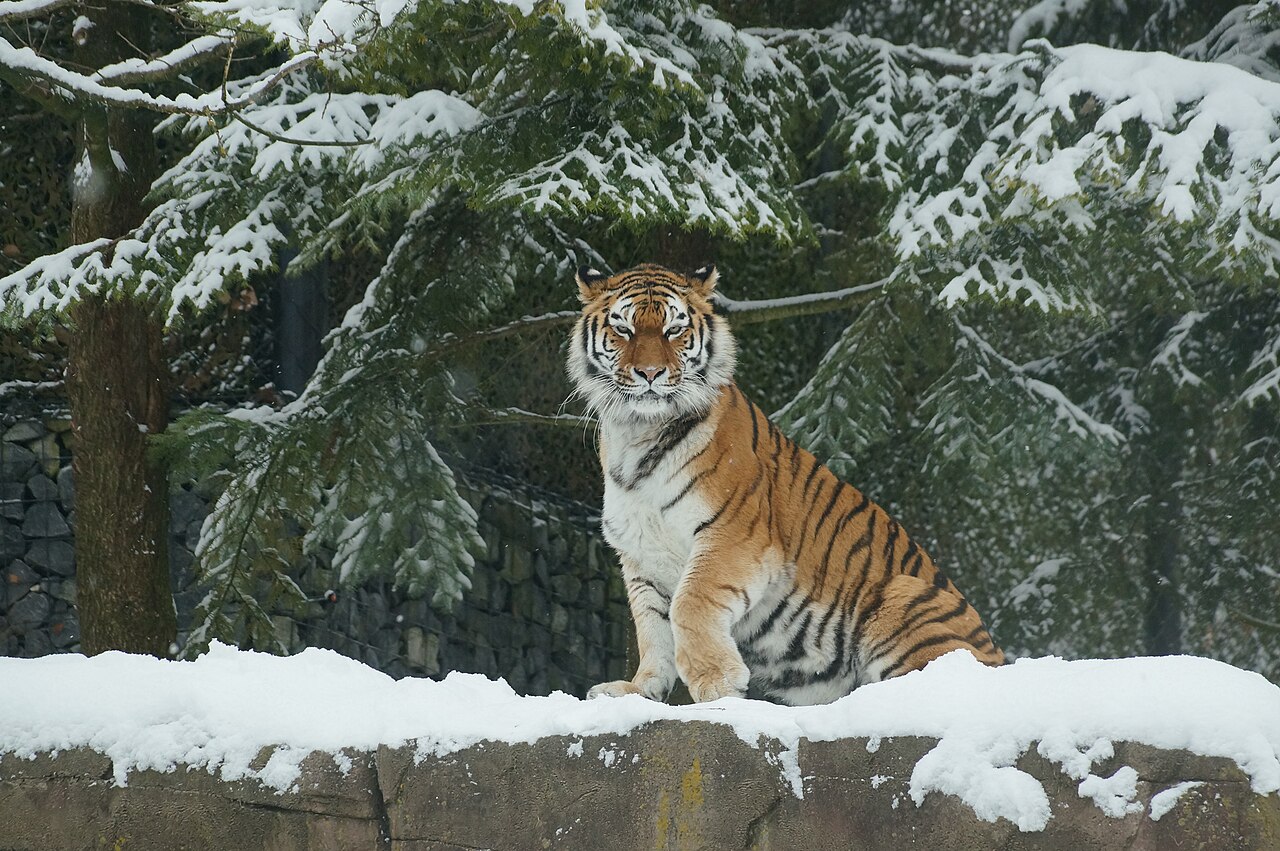
The Siberian tiger, also known as the Amur tiger, is a population of the tiger subspecies Panthera tigris tigris native to Northeast China, the Russian Far East, and possibly North Korea. Currently, it inhabits mainly the Sikhote-Alin mountain region in the southwest of Primorsky Krai in the Russian Far East. The Siberian tiger is genetically close to the now-extinct Caspian tiger, and its population has fluctuated due to conservation efforts and environmental pressures.
- Scientific name
- Panthera tigris tigris (Siberian population)
- Native region
- Northeast China, Russian Far East, possibly North Korea
- Genetic relation
- Closest living relative of the extinct Caspian tiger
Lore & Background
The Siberian tiger was described under several scientific names in the 19th century, including Felis tigris altaicus, Tigris longipilis, Felis tigris var. amurensis, and Felis tigris coreensis, based on variations in fur length, colouration, and body size. The Siberian tiger is reddish-rusty or rusty-yellow with narrow black transverse stripes, a body length of at least 150 cm, and a condylobasal skull length of 250 mm.
Reader's Guide
The Siberian tiger's significance lies in its status as a northern population of the mainland Asian tiger subspecies, Panthera tigris tigris, and its close genetic relationship to the extinct Caspian tiger. Genetic studies have revealed low mitochondrial DNA diversity in the wild population, suggesting a recent bottleneck, while captive tigers retain higher diversity. The population is divided into two groups separated by a development corridor in Russia, and maintaining ecological connectivity is critical for genetic diversity.
Did You Know?
- The Siberian tiger is genetically the closest living relative of the now-extinct Caspian tiger.
- The Siberian tiger was also called 'Amur tiger', 'Manchurian tiger', 'Korean tiger', and 'Ussurian tiger' depending on the region.
Genetic Origins and the Silk Road Migration
Phylogeographic analysis has revealed a remarkable story of how the Siberian tiger came to occupy the Russian Far East. The common ancestor of both the Siberian and the now-extinct Caspian tiger populations originated in eastern China and migrated westward through the Gansu region along what would later become the Silk Road corridor. From that central position, the lineage then traversed eastward to establish the population that would become the Siberian tiger in the Russian Far East. For centuries, these two populations formed a single contiguous group spanning a vast geographic range. It was not until the early nineteenth century that the two groups began to separate, a process driven by habitat fragmentation and land-use changes associated with the Industrial Revolution. The genetic closeness between Siberian and Caspian tigers, confirmed by mitochondrial DNA sequencing of museum specimens, stands as one of the strongest pieces of evidence for this shared recent ancestry.
The Subspecies Identity Debate
The Siberian tiger's taxonomic status has been a point of sustained scientific contention. Under that framework, the Siberian tiger would simply be one population within the broader P. t. tigris group spanning mainland Asia.
Stature and Coat Characteristics
The Siberian tiger ranks among the largest living cat species on Earth, a distinction it shares with its closest genetic relative, the Caspian tiger. While the Caspian tiger's fur was generally brighter and more uniform in background color, the Siberian coat displayed a sharper contrast between its summer and winter pelts than any other tiger population. The winter coat was notably paler with less distinct striping, while the summer coat carried a density and hair length comparable to that of the Bengal tiger, though the Siberian's stripes tended to be broader and more widely spaced than the narrower, more closely set patterns seen in Caspian specimens. Pure black markings on the head, neck, mid-back, and tail tip were a shared feature, but the angular patterns at the tail base were less developed in Caspian individuals than in Far Eastern populations. Some Caspian tigers fell intermediate in size between the Siberian and Bengal forms, underscoring how closely these lineages were related before their geographic separation.
Fragmentation and Divergent Fates
Until the early nineteenth century, the Siberian and Caspian tigers were not separate populations at all but parts of a single, continuous range stretching from the Russian Far East across Central Asia to the Xinjiang region of western China and the Caucasus around the Caspian Sea. This vast corridor of sparse forests and riverine habitats allowed gene flow between the two groups for millennia. The Industrial Revolution shattered that connectivity. Habitat loss and fragmentation progressively isolated the western Caspian population from its eastern Siberian counterpart. The consequences were asymmetric: the Caspian tiger, confined to an increasingly narrow range spanning eastern Turkey, northern Iran, Mesopotamia, and parts of Central Asia, was assessed as extinct in 2003. The Siberian tiger, though also pressured, retained a foothold in the Russian Far East. The genetic record—low mitochondrial DNA variability in Caspian specimens and remarkable similarity to Siberian individuals—bears witness to how recently these two populations were one and how quickly human-driven landscape change can sever that bond.
Common Misconceptions (Editorial)
1. Some people think the tiger species of this region are unrelated; however, the Siberian tiger is genetically the closest living relative of the extinct Caspian tiger.
2. There is a misconception that "Siberian tiger" is the only historical name, but it has also been called the Amur tiger, Manchurian tiger, Korean tiger, and Ussurian tiger depending on the region.
Why It Matters (Editorial)
The Siberian tiger endures as a powerful symbol of wilderness and conservation, representing both the fragility and resilience of a species pushed to the brink by habitat loss and poaching. Its survival in the remote Sikhote-Alin mountains reflects ongoing efforts to balance human development with the protection of one of the world’s most iconic predators.
Gallery

Frequently Asked Questions
Who is the Siberian tiger?
The Siberian tiger, commonly called the Amur tiger, is a northern population of the tiger subspecies Panthera tigris tigris. It is the largest surviving wild tiger population and is genetically closest to the now-vanished Caspian tiger.
Why is the Siberian tiger important?
As the largest surviving wild big-cat population, it acts as an umbrella species whose protection safeguards entire forest ecosystems in the Russian Far East. Its continued existence hinges on balancing poaching pressures with habitat conservation and prey availability.
More in Big Cats 1-22
Spotted an error? Know more?
This is a living reference — every entry is fact-audited, and reader corrections feed straight into our audit queue. Suggest an edit · See this site's audit record