Frequently Asked Questions
The most-asked questions about big cats.
What exactly are 'big cats'?
The term refers to the five species in the genus Panthera: lion, tiger, jaguar, leopard, and snow leopard. They are set apart from smaller wild cats by a partially flexible hyoid bone in the larynx that lets them produce a deep roar.
How many big-cat species are there, and where does each live?
There are five recognized species, each on a different continent: lions in Africa, tigers across South and Southeast Asia, jaguars in Central and South America, leopards in Africa and parts of Asia, and snow leopards in the mountain ranges of Central and West Asia. No two species share a natural range.
What is the single most important physical trait that separates big cats from other felids?
It is the structure of the larynx: a partially ossified hyoid bone that allows a powerful roar but prevents continuous purring. Smaller wild cats, which have a fully flexible hyoid, can purr on both the in-breath and out-breath but cannot roar.
Which big cat is the largest?
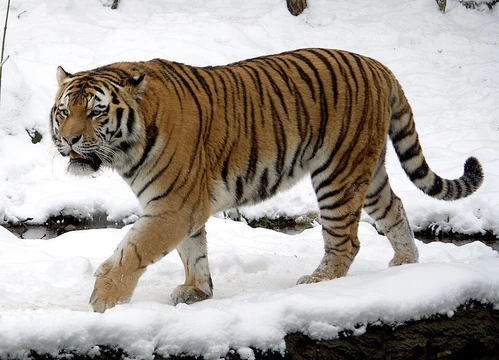
The tiger is the heaviest and longest, with adult males reaching roughly 300 kg and over three metres nose-to-tail. The lion is second, and the snow leopard is the smallest of the five at around 30–55 kg.
How do big cats typically hunt?
They are ambush predators that stalk close to their prey, then launch a short burst of explosive speed to deliver a killing bite to the throat or upper spine. Most hunt at dawn, dusk, or night, and a single kill can sustain an individual for several days.
What is the conservation status of the big cats?
All five species are listed as threatened on the IUCN Red List, ranging from Vulnerable (lion, leopard, jaguar) to Endangered (tiger, snow leopard). The main pressures are habitat fragmentation, poaching for the illegal wildlife trade, and declining prey populations.
Can all big cats roar, and can they purr?
All five Panthera species can roar, though the snow leopard's vocalization is much quieter and more guttural than a lion's or tiger's. Because of their laryngeal anatomy, they generally cannot purr continuously the way a domestic cat does.
What is a lion 'coalition' and why does it matter?
A coalition is a small group of related males—often brothers—who join forces to wrest a territory from a rival group and share access to a pride's females. These partnerships can last from a few months to several years and are key to lion social structure.
Where can a newcomer observe big cats responsibly?
Accredited zoos and wildlife sanctuaries offer close-up viewing alongside education and breeding programs, while in the wild guided safaris in East Africa, tiger reserves in India, and ecotourism lodges in Brazil's Pantanal are well-established options. Choosing operators that reinvest revenue into local conservation is the most responsible approach.
What is a good starting point for someone who wants to learn more about big cats?
A solid first step is to pick one species and follow a long-running documentary series or a well-reviewed field guide that covers its ecology, behavior, and threats. From there, exploring peer-reviewed journals such as Oryx or the IUCN Species Specialist Group pages will give deeper, up-to-date context.